

Building Tomorrow: Robotics Integration in Indian High School Science Education
by LORENZ BARMAN
In the dynamic landscape of Indian high school education, a technological renaissance is underway—a revolution that transcends textbooks and classrooms. The integration of robotics class modules into science education is not merely an educational innovation; it is a visionary leap into a future where Indian students are not just consumers of technology but architects of the nation’s technological advancement.
As India endeavors to position itself as a global tech powerhouse, nurturing a workforce proficient in robotics is paramount. The introduction of robotics in high school science education marks a transformative step towards achieving this goal. Beyond the gears and circuits, robotics education instills a set of skills that extends far beyond the traditional science curriculum, preparing students to be leaders in a world driven by technological innovation.
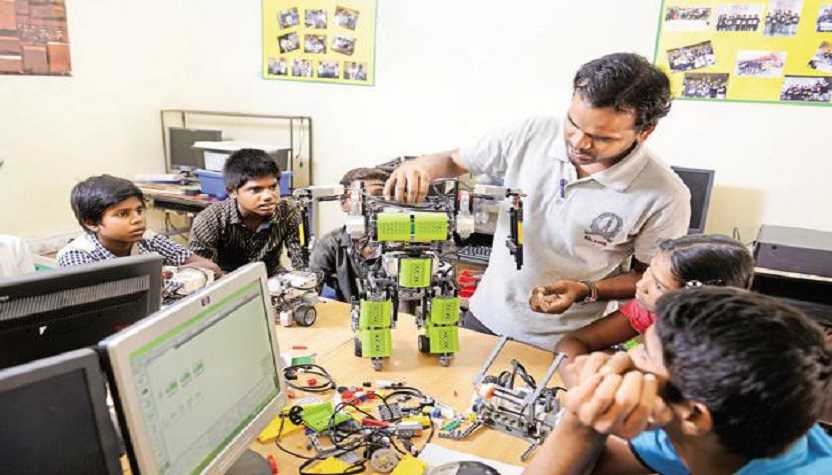
One of the primary benefits of integrating robotics into high school science education lies in its ability to foster critical thinking and problem-solving skills. Robotics projects require students to conceptualize, design, and execute solutions to real-world problems. As students grapple with building and programming robots, they learn to break down complex challenges into manageable components—an invaluable skill that transcends the boundaries of science education and is applicable across various academic and professional domains.
Moreover, robotics education promotes a multidisciplinary approach, bridging the gap between science, technology, engineering, and mathematics (STEM). The design and construction of robots necessitate an understanding of physics, mathematics, and computer science, creating a holistic learning experience that reflects the interconnected nature of modern technology. This multidisciplinary approach not only enriches the educational experience but also ensures that students are well-rounded and equipped to tackle the complexities of the technological landscape.
Robotics class modules also contribute to nurturing a culture of innovation and entrepreneurship. Through hands-on projects, students learn to think creatively, experiment with ideas, and develop a deep understanding of the iterative design process. This entrepreneurial mindset becomes a driving force behind technological advancements, positioning students as future innovators and contributors to India’s evolving tech ecosystem.
Furthermore, the integration of robotics in high school science education aligns with India’s vision of Industry 4.0. As automation, artificial intelligence, and robotics redefine industries, a workforce well-versed in these technologies becomes crucial. High school students exposed to robotics education are not just preparing for future jobs; they are preparing to lead in an era where robotics is central to manufacturing, healthcare, and various other sectors, contributing to India’s technological advancement on the global stage.
The societal impact of robotics education in high schools is profound. By demystifying technology and making it accessible, schools are cultivating a generation that views technology not as an intimidating force but as a tool for empowerment. This approach ensures that students, regardless of their background, feel inspired to explore and contribute to the evolving technological landscape, fostering diversity and inclusivity in the field of robotics and technology.
In conclusion, the integration of robotics class modules into Indian high school science education is a strategic investment in the nation’s technological future. It is a journey into a future where students are not just academically proficient but technologically adept, ready to harness the power of robotics to shape India’s destiny. The classrooms of today are not just teaching robotics; they are incubators for a generation that will lead India’s technological advancements, driving innovation, and propelling the nation towards a future where technology is not just embraced but created.
Copyright @ 2024 LORENZ BARMAN